Starting Paragliding with Parakite: is it really possible?
Everyone is talking about Parakite
Everyone is talking about Parakite
Driven by spectacular videos on social media and the promise of total three-dimensional freedom, starting paragliding with Parakite is a question more and more pilots are asking, especially those coming from kiting or aerial sports.
Can you start directly with Parakite without first learning paragliding?
The short answer is: yes.
But not just any way.
Between the illusion of simplicity and the reality of an aerial sport, here is what you need to understand to start safely and build, over time, a genuine pilot’s progression.

Why Is Parakite So Attractive?
Parakite has strong appeal, particularly among board-sport riders (kiteboarding, wing foiling) and also skydivers. It promises a unique combination: the freedom of paragliding paired with power management closer coming form the kite.
1. An Immediate Sense of Safety: Depower
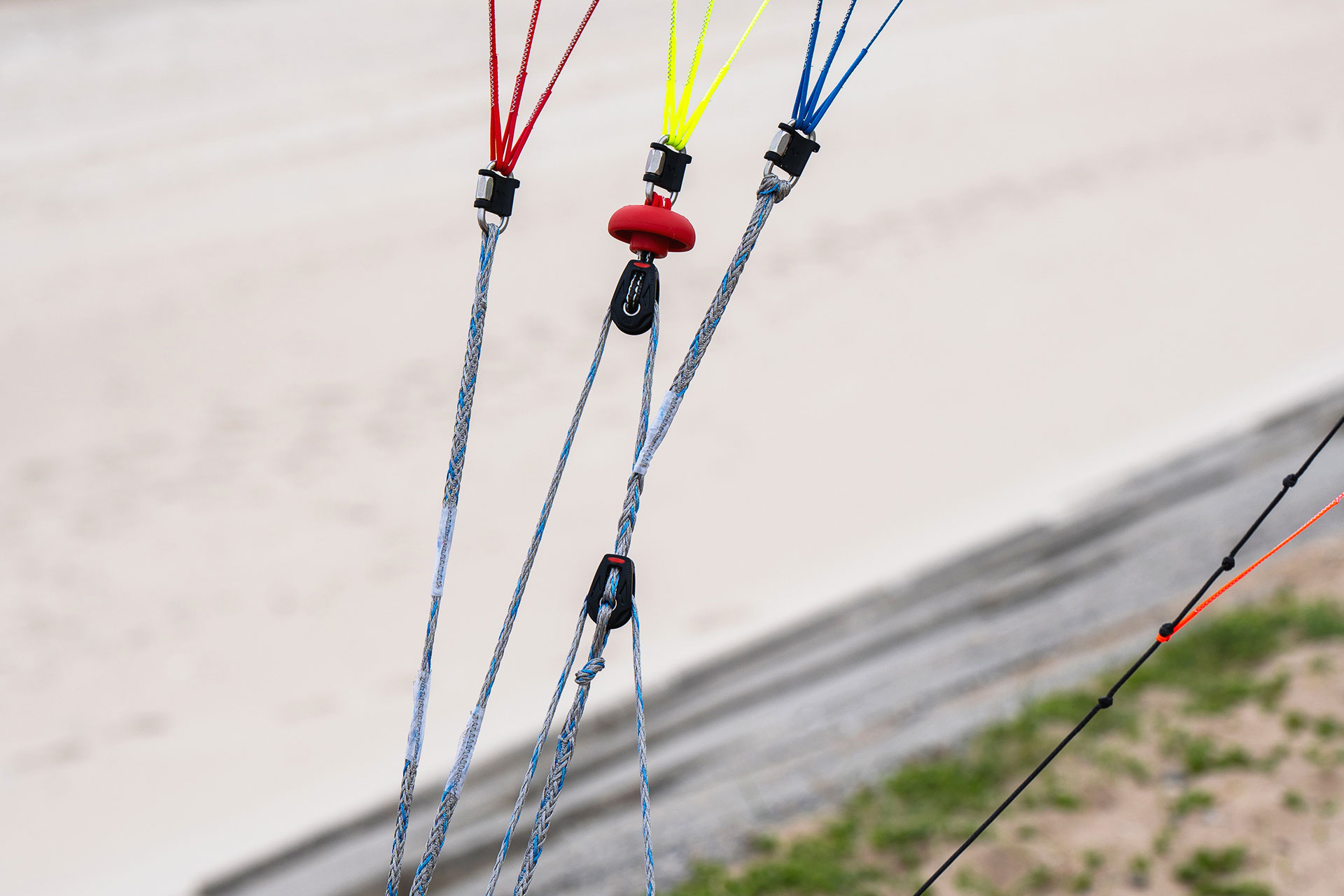
On the ground, Parakite offers a major advantage for beginners: depower.
Unlike traditional paragliding—where winds above 20 km/h already require solid technique to remain in control and avoid being overpowered by the wing—Parakite makes it easier to position the wing at the edge of the window without generating excessive pull.
•Hands up, the wing flies at low angle of attack: airflow speed over the profile increases without generating lift
•Hands down, the angle of attack increases, allowing lift to be generated
Imagine a pilot standing on the ground, hands up, wing overhead at the zenith.
In paragliding, beyond a certain wind speed, this situation can lead to an unwanted take-off.
In Parakite, the control system means that with hands up, the wing adopts an angle of attack and airspeed that do not generate sufficient lift to take off without active input on the controls.
This behaviour provides a safety felling for beginners.
2. Faster Access to Three-Dimensional Flying
Parakite wings, such as the Flare Moustache, are designed to be playful. They allow the pilot to dive to build speed, then to play with a much larger energy range than in traditional paragliding.
Pilots quickly experience sensations of glide, speed, and proximity to terrain that would otherwise require years of practice to achieve with the same level of precision in conventional paragliding.
Is it to easy ?
This is where the Parakite paradox lies.
The equipment is easy to access, but this apparent simplicity can hide the fact that flying remains an aerial activity requiring progressive learning over time.
A Forgiving Wing
Parakite technology relies in part on a flight-mechanics principle that was long underused in paragliding: the reflex profile.
The defining feature of a reflex profile lies in its design: the trailing edge of the wing is deliberately “released,” allowing it to rise naturally. This geometry generates a stabilising aerodynamic force that prevents the wing from entering a low-angle-of-attack condition and significantly limits the risk of collapse.
Wings designed around this concept therefore tend not to overshoot the pilot and to stop before collapsing. In certain phases, they require less active piloting in relation to one of the main risks in paragliding: frontal collapses.
When roll or pitch movements exceed a certain amplitude, paragliding requires the pilot to maintain brake pressure with precise timing to prevent collapse.
In Parakite, this vigilance is no longer necessary in the same way: thanks to the reflex effect, the wing will not collapse easily — only if the system is fully operational (proper brake settings, clean trailing edge, no sand contamination, etc.).
Overall, Parakite wings tend to be more forgiving when the wing–pilot system enters instability (roll or pitch).

One Less Safety Barrier
This tolerance increases safety, but it also removes an important pedagogical safeguard.
In paragliding, the need for slow progression naturally enforces learning about spatial management and energy dissipation.
In Parakite, some pilots quickly discover that they can generate large angles and significant amplitude without yet having the corresponding technical skills. Add to this the demonstrative nature of the discipline—the presence of spectators, the temptation to “put on a show”—and the risk increases.
It is not uncommon to see near-beginner pilots initiating very committed trajectories close to the ground, with insufficient mastery but an extremely tolerant wing.
However, dynamic proximity flying requires long, progressive, and rigorous training.
Playing with the energy of the wing–pilot pendulum system demands great caution and very precise control—both through the controls and through weight-shift, which plays a particularly important role in Parakite piloting.
What Is a Reflex Profile? (A Simple, Practical Definition)
The trailing edge naturally adopts an upward shape.
This reflex effect creates aerodynamic resistance that stabilises the wing, prevents it from overshooting too far forward in the window, and greatly limits frontal collapses—even hands up, with a strongly diving profile.
➡️ The result: a wing capable of flying fast, very steep, and yet extremely resistant.
Parakite Soaring : Coast vs Mountain
Parakite is primarily a soaring activity, most often practiced along the coast.
Can a pilot who feels comfortable flying in 20–30 km/h of smooth, laminar wind on a beach transfer those skills to any paragliding site?
The answer is clearly no.
Mountain flying involves:
•refined reading of aerology,
•understanding of thermals,
•much more complex condition analysis.
Even if, in theory, a Parakite wing is more resistant to collapses, it still requires deep understanding of:
•pendular movements (roll and pitch),
•energy dissipation,
•safety margins relative to the ground.
Control System and Operational Framework
In Parakite, the controls do not simply brake the trailing edge as in paragliding. They change the angle of attack of the entire wing. This control system is highly effective, but it involve a different flying philosophy and requires specific training.
It is important to remember that Parakite wings are primarily designed for soaring in laminar conditions, particularly along the coast. It is in this specific context that their potential is highest and where we currently have the greatest amount of operational feedback.
Outside these conditions, our knowledge remains largely empirical: there is no dedicated certification standard, formalised data, and relatively few documented incidents (collapses, behaviour in degraded aerology, etc.).
This does not mean that these wings are dangerous, but rather that their use outside their preferred domain requires great caution—particularly in the choice of aerological conditions.
Parakite should not be approached as a conventional paragliding wing usable everywhere, but as a discipline in its own right, with its own limits and framework of practice.
Self-Stability = High Passive Safety
The Parakite airfoil is designed to remain solid when accelerated. This principle already existed to some extent in high-performance paragliding wings, which gain stability when accelerated.
Parakite pushes this concept much further: pronounced reflex, dedicated geometry, and superior hands-up stability.
The Right Way to Start: Slow Down to Progress Faster
Starting directly with Parakite is possible, provided you do not seek immediate speed or adrenaline.
1. Spend Time on the Ground
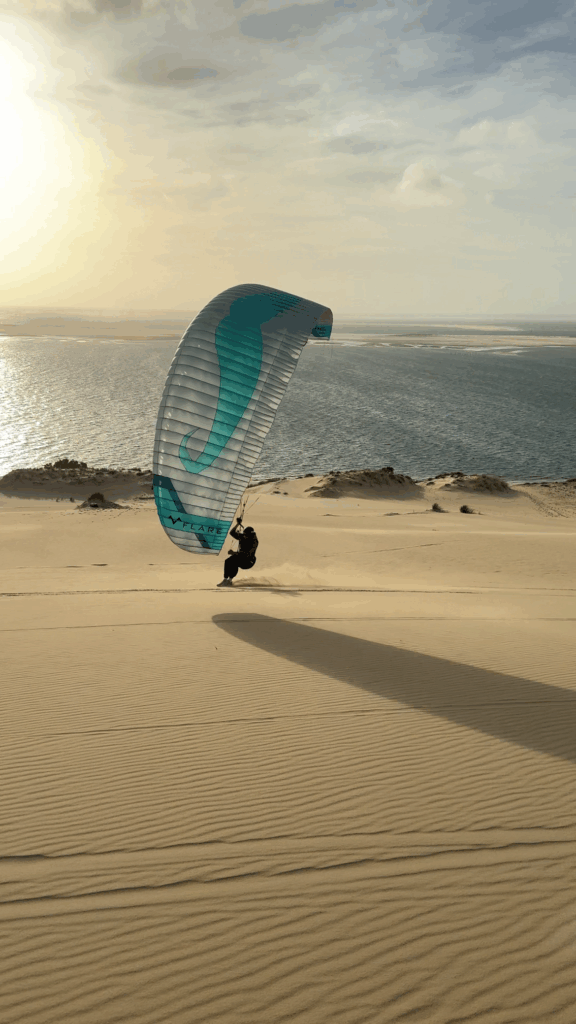
Ground handling is fundamental. It allows pilots to understand energy management before even leaving the ground.
Flying should then be approached progressively, at low height, to develop:
•precise control inputs,
•correct turning technique,
•the ability to read terrain and wind.
Exploring new situations, stepping outside your comfort zone while maintaining optimal safety margins, takes time.
2. Master Slow Flying
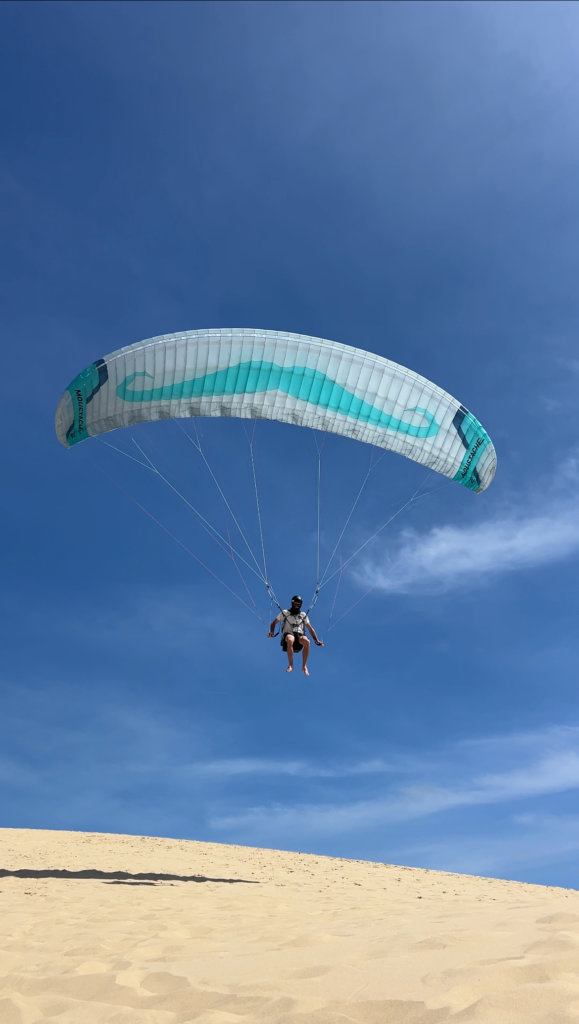
Before to aime for speed, you must learn to fly slowly.
Depending on design and setup(so not every models), some Parakite wings can reach very low airspeeds—sometimes even flying backwards relative to the ground—thanks to stabilised parachutal flight. This behaviour is not universal: it depends closely on the wing profile, trim, and aerological conditions.
The key exercise is to explore heavily braked flight at reduced speed, close to the ground on gentle terrain. The goal is not to find the limit, but to refine control precision, better perceive the approach to stall, and progress safely.
3. Turning
It is also essential to become familiar with turn radius, the speed required for an efficient turn, and the subtle use of weight-shift in the harness to support the trajectory and reduce the load on the controls.
Every turn generates speed.
Learning how much space is required to dissipate this energy is really important.
This involves:
•control of turn radius,
•speed management,
•effective use of body weight.
Proximity flying cannot be improvised.
Equipment and Training: Where Do We Stand?
Equipment: Towards “School” Wings
Until now, available wings have been versatile and high-performing—sometimes too dynamic for complete beginners.
From 2026 onward, manufacturers—particularly Flare—will introduce models specifically designed for training, offering greater tolerance and a more progressive learning curve. At the same time, new high-performance wings are being developed for expert pilots.
Training: A Limited Resource
Demand is growing rapidly, but training opportunities remain scarce.
Last year, only 12 instructors were specifically trained in Parakite through a FFVL programme that I had the honour of supervising.
To help meet this demand, FlyParakite offers:
•5 initiation courses in spring, starting March 30, 2026,
•5 progression courses,
•limited to 4 participants per course for personalised coaching,
•with additional dates possible depending on demand.
Conclusion: Go for It—But with Humility
Yes, Parakite is an exceptional gateway into the world of paragliding. It is a modern, playful, and technically fascinating discipline.
But it remains an aerial sport: once flying, you cannot simply “let go” as you would drop a kite bar into the water.
To progress safely and enjoy it long-term:
1.Train with qualified professionals.
2.Accept that learning takes time.
3.Respect sites and local rules.
4.Never overestimate your skill level just because the equipment is forgiving.
Ready to discover the third dimension?