Paraglide vs Parakite Understanding the Difference
At first glance, a paraglider and a Parakite look very similar: a wing, lines, a harness, and a pilot suspended underneath. Yet from the very first seconds with the controls in hand, it becomes clear that the two machines have very little in common in the way they fly.
Parakite does not break away from paragliding, but it introduces a different piloting logic. This evolution opens up new possibilities, and the discipline is only just beginning to reveal its full potential.
What does this change in terms of control ?
Paragliding: Piloting Based on Trailing-Edge Control
The handling of a paraglider mainly comes from brake input.
By pulling on the controls, the pilot acts directly on the trailing edge:
•the trailing edge is lowered,
•the curvature of the airfoil increases,
•lift and drag both increase.
In stabilised flight, a paraglider does not experience large variations in angle of attack. The pitch attitude of the airfoil may change slightly, but significant changes in angle of attack mostly occur during dynamic manoeuvres or in turbulent air.
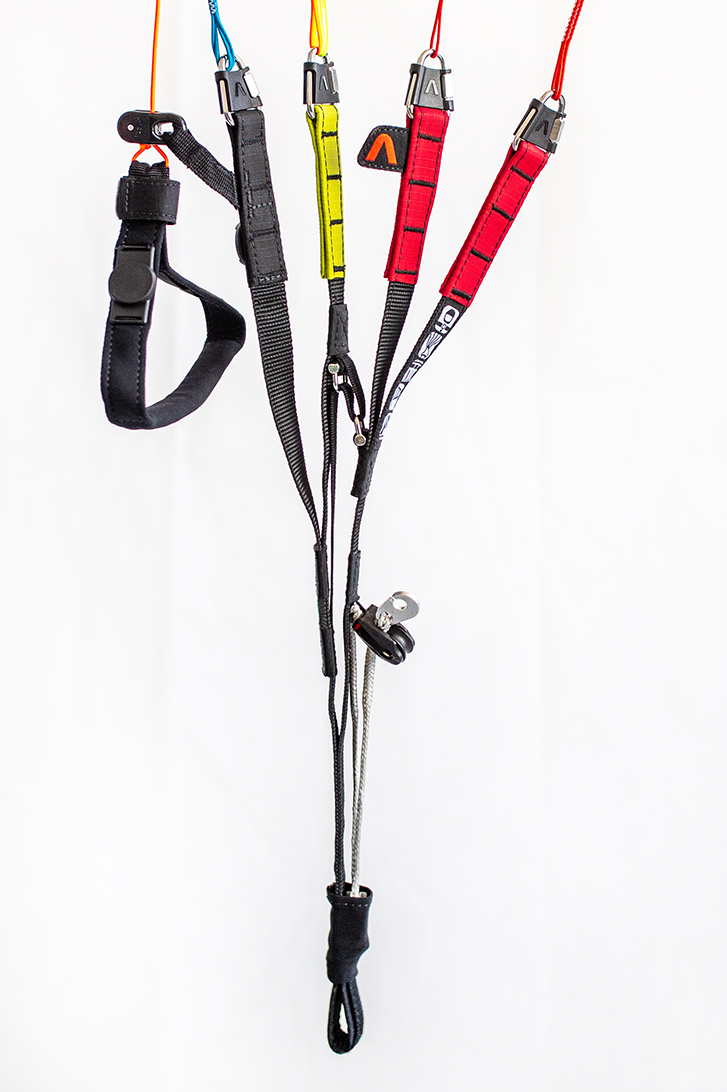
Parakite: Piloting Based on Airfoil Pitch
In Parakite, the controls work in a very different way:
•pulling on the controls pitches the airfoil up,
•raising the hands pitches it down.
The control input acts on the entire geometry of the wing, not just on the curvature of the trailing edge.
This gives the pilot much more direct control over pitch: hands up produce a steeper, more diving trajectory, while dynamic braking can generate far more energetic lift than in paragliding.
👉 This is the most fundamental difference between the two.
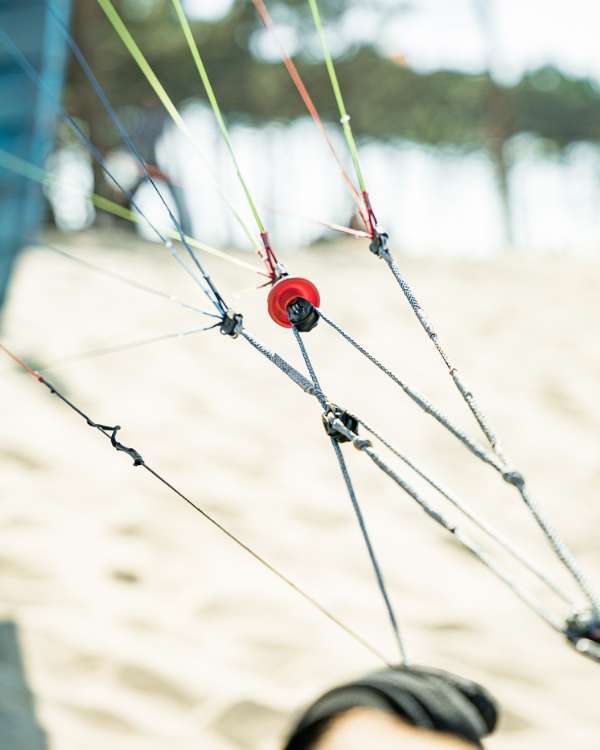
Parakite: Why “Hands Up” Produces a Diving Profile
Hands-Up Behaviour: Paragliding vs Parakite
In paragliding, hands up corresponds to maximum speed, but the airfoil remains globally “flat”.
In Parakite, hands up means a diving profile: the angle of attack decreases, speed increases, yet the wing remains solid without triggering a frontal collapse.
The two technical elements that make Parakites stable
his stability, despite a low angle of attack, comes directly from the airfoil design, which is intended to fly safely at these extreme attitudes:
•A pronounced reflex profile: the trailing edge naturally rises as the wing accelerates, stabilising the airfoil.
•High internal pressure: the internal structure maintains the wing’s volume and rigidity.
Thanks to this combination, a Parakite remains stable hands up in configurations where a conventional paraglider would quickly collapse.
What is a Reflex Profile ?
The trailing edge naturally adopts an upward shape.
This reflex effect creates aerodynamic resistance that stabilises the wing, prevents it from overshooting too far forward in the window, and greatly limits frontal collapses—even hands up, with a strongly diving profile.
➡️ The result: a wing capable of flying fast, very steep, and yet extremely resistant.
Paragliding vs Parakite: What Changes in Flight
In Paragliding: Stopping the Wing as Soon as It “Attacks”
In paragliding, pilots have to act very quickly on the brakes as soon as they feel a reduction in angle of attack—often perceived as a sudden lightening of brake pressure.
This reaction is logical: a paraglider does not tolerate abrupt decreases in angle of attack well, whether caused by aerology or by a dynamic movement such as a pitch surge that must be checked.
As a result, pilots instinctively learn to restrain the wing as soon as it starts to move too far ahead.

In Parakite: The Opposite Logic (Hands Up, Let It Fly)
In Parakite, in moderately turbulent air, the most stable configuration is generally hands up, allowing the wing to work freely.
For pilots coming from paragliding, this is disconcerting. It requires accepting more small movements and letting the wing filter the airflow on its own, instead of trying to control everything.
Self-Stability = High Passive Safety
The Parakite airfoil is designed to remain solid when accelerated. This principle already existed to some extent in high-performance paragliding wings, which gain stability when accelerated.
Parakite pushes this concept much further: pronounced reflex, dedicated geometry, and superior hands-up stability.
The Limits: Parakite Stability Depends on Trim
Why a Parakite Must Be Perfectly Trimmed
For the reflex effect to function fully, several conditions must be met.
The effectiveness of a reflex profile directly depends on:
• a correctly trimmed wing,
• the absence of knots or line twists,
• strict adherence to the manufacturer’s settings.
Over time, poor trim can develop due to:
• shortening lines
• unintended knots,
• sand accumulation in the trailing edge.
All of these factors significantly degrade profile stability.
A Parakite offers strong passive safety—but only with a healthy, correctly adjusted wing.
Conclusion: Two Piloting Logics to Understand
The difference in piloting between paragliding and Parakite explains much of the new sensations pilots discover under these wings. But to truly understand where Parakite expresses its full potential—and where it can become more technical—it is also necessary to consider the environment in which it is flown.
That is exactly what I will explore in the next article:
👉 Coastal sites, soaring, mountains: in which conditions does Parakite really work?
And why some terrains suit it perfectly… while others do not at all